
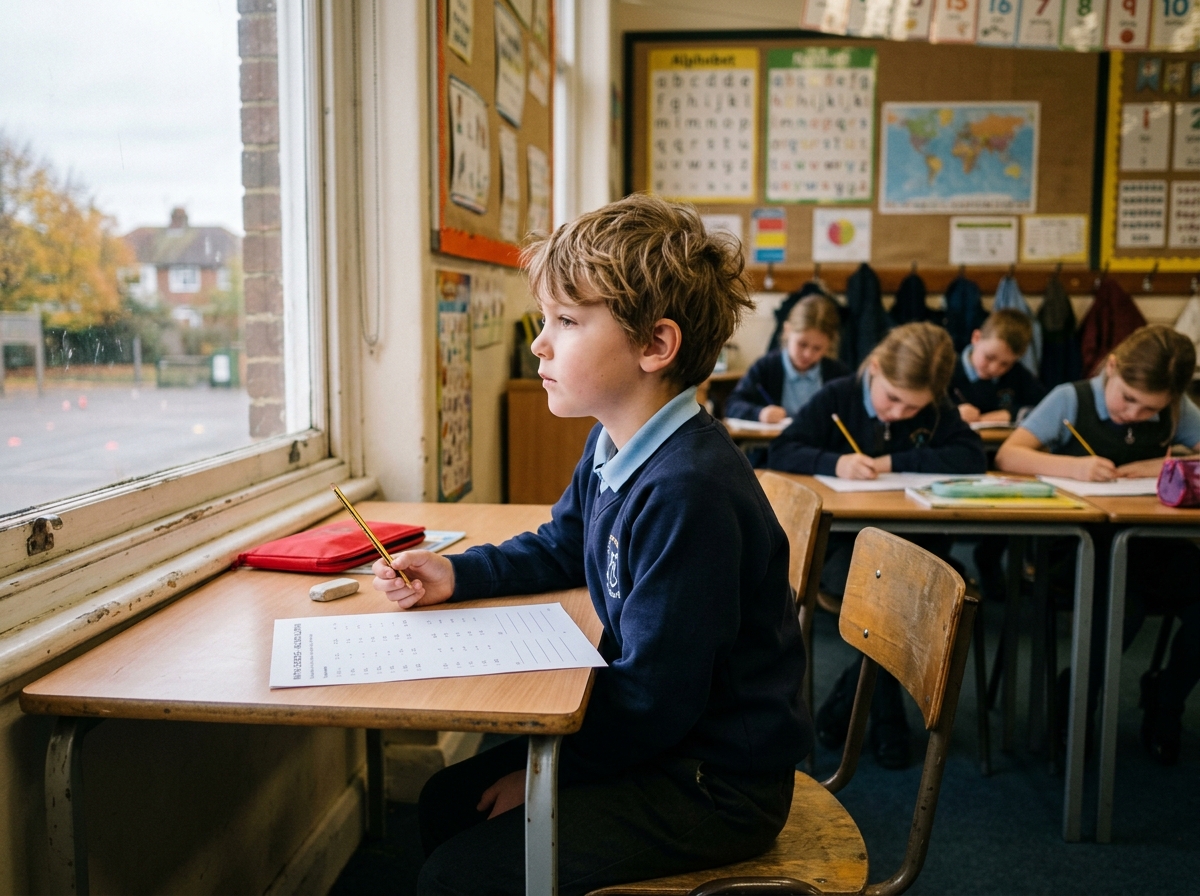
TL;DR: ADHD in children rarely looks like the textbook description. It looks like a bright, loving child who is exhausted by their own brain — and a parent who has been quietly frightened for longer than they want to admit. This article walks through what ADHD actually looks like day to day, which symptoms are most commonly missed, and what to do when you are stuck in the waiting room between suspicion and diagnosis.
The Evening That Changes Things
It started with a reading group.
Sophie was in Year 2 and her teacher had asked to speak after school. Nothing dramatic — a gentle, careful conversation. The kind where the teacher chooses her words slowly. He’s such a joy to have in class. He’s so creative. We’re just noticing that he’s finding it hard to… stay on task.
His mum, Claire, nodded and thanked the teacher and walked to the car and sat there for a moment before starting the engine.
She had been noticing things too. Had been noticing them for a year, maybe longer. The homework that should take twenty minutes and takes two hours. The mornings that detonate without warning — socks that feel wrong, a cereal bowl in the wrong place, an argument that starts nowhere and ends with everyone crying. The fact that he can spend forty-five minutes building an intricate Lego spaceship but cannot hold a pencil for five.
She had talked herself out of it, the way you do. All kids are a bit like this. He’s just spirited. He’s a boy. He’ll grow out of it.
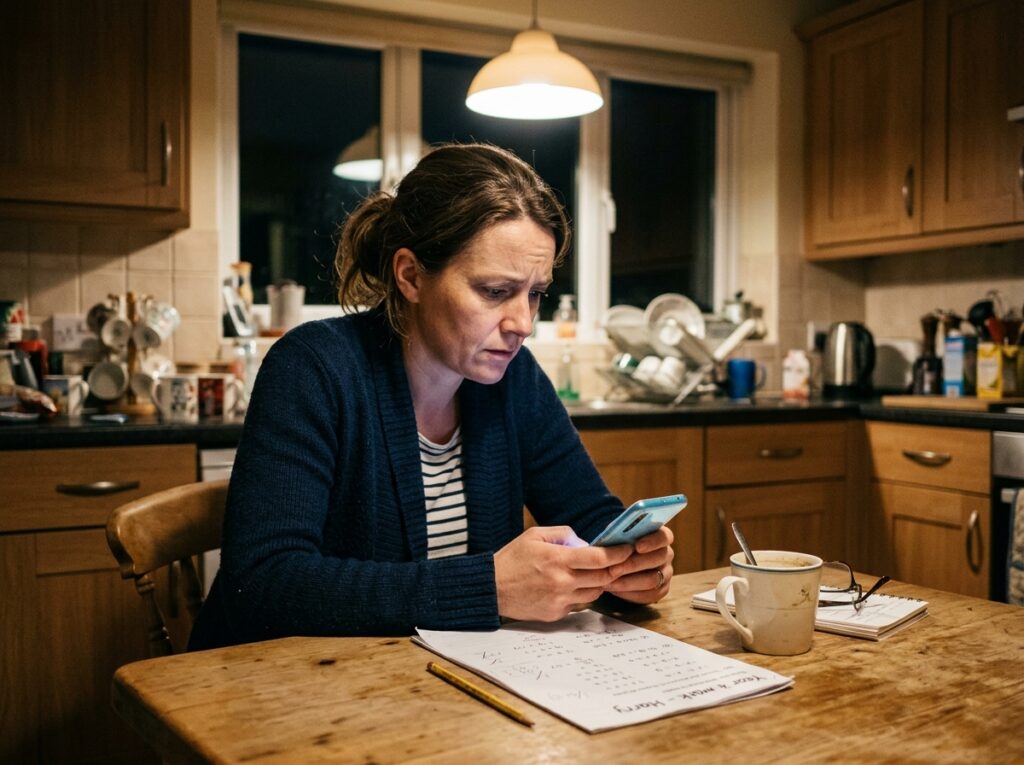
And now she was sitting in a car park Googling “ADHD symptoms in kids” and feeling, in equal measure, terrified that she would find her son on the page and terrified that she would not.
If you are reading this, you are probably sitting somewhere similar.
What ADHD in Children Actually Looks Like
The NHS criteria are not wrong. Inattention, hyperactivity, impulsivity — these are real, and they matter. But they are written in clinical language designed for diagnosis, not for recognition. They do not tell you what Tuesday morning looks like.
ADHD in children looks like this:
A child who is told to get their shoes on and, ten minutes later, is found in the garden watching a beetle. Not because they do not care. Because something happened between the instruction and the hallway and their brain took a different route entirely.
It looks like a child who bursts into tears at a birthday party because the game changed and they were not ready for it. Who cannot explain why they are upset, only that everything suddenly felt too loud and too fast and too much.
It looks like a child who reads the same sentence four times and still cannot tell you what it said. Whose eyes are on the page and whose mind is three fields away.
It looks like a child who talks constantly — brilliantly, imaginatively — and cannot stop, not because they are rude, but because the words are already coming out before the thought of stopping has formed.
It looks like a child who forgets their PE kit every single week despite a note on the fridge, a reminder from you at breakfast, and a reminder from them to themselves at the school gate.
The thing most parents do not expect is the inconsistency. A child with ADHD can concentrate for hours on the things that genuinely absorb them. Gaming. Drawing. A YouTube rabbit hole about sharks. This is not a choice. It is called hyperfocus, and it is part of the same neurological pattern as the inattention — both driven by how the ADHD brain regulates dopamine. The child is not choosing to focus on Minecraft and choosing not to focus on maths. Their brain is responding to stimulation in a way that is outside their conscious control.

The Symptoms That Get Missed Most Often
The hyperactive-bouncing-off-walls version of ADHD is the one people picture. It is also the one most likely to be caught early, particularly in boys, because it is visible and disruptive and hard to overlook in a classroom.
The symptoms that get missed are quieter.
| Commonly Missed ADHD Symptom | What It Looks Like in Real Life |
| Inattentive type (no hyperactivity) | Dreamy, forgetful, seemingly switched off — often missed in girls |
| Emotional dysregulation | Big reactions to small triggers, difficulty calming down |
| Rejection sensitivity | Extreme distress at criticism, perceived failure, or social exclusion |
| Executive function difficulties | Cannot start tasks, cannot switch between tasks, loses things constantly |
| Time blindness | No sense of how long things take; perpetually late; cannot plan ahead |
| Sleep difficulties | Cannot switch off at night; overtired but wired |
Girls, in particular, are diagnosed significantly later than boys — often not until secondary school or even adulthood. Girls with ADHD are more likely to present as inattentive, anxious, and socially overwhelmed rather than disruptive, which means they spend years being labelled as sensitive, scatty, or not trying hard enough. ADHD Foundation
If your daughter is bright, articulate, and working hard but still struggling, and she has been told she just needs to focus more — trust the thing you are noticing.
The Two Fears You Are Holding at Once
Here is the thing nobody says out loud.
When you are at this stage — searching, suspecting, not yet knowing — you are not holding one fear. You are holding two contradictory ones simultaneously.
The first is that your child has ADHD and you have been too slow to act. That you missed the signs. That earlier intervention would have changed something important.
The second is that your child does not have ADHD and you are pathologising normal childhood behaviour, that you are one of those parents who medicalises everything, that a well-meaning relative is right when they say all kids are like this.
Both fears cannot be true at once. But they both feel true right now, and that is an exhausting place to live.
A checklist will not resolve this for you, because a checklist requires you to interpret what “often” means and “more than other children” and whether your frame of reference is accurate. What resolves it is professional assessment — and getting there is harder than it should be.

What to Do When You Are Stuck Waiting
You have seen your GP. You have a referral. You are now waiting — perhaps three months, perhaps six, perhaps longer. This is where most parents feel stranded.
There are things worth doing in the meantime.
Start a behaviour diary. Write down specific incidents — not impressions, specifics. Date, time, what happened, what preceded it, how long it lasted. This documentation is valuable evidence for an assessment and often accelerates the process when you arrive with concrete records rather than memories.
Ask your child’s school for an SENCO referral. The Special Educational Needs Coordinator can begin their own observation process independently of the NHS pathway, and schools can put support in place before a diagnosis is confirmed. You do not need a formal diagnosis to ask for adjustments.
Look into private assessment if waiting is affecting your child’s education or wellbeing significantly. The cost is real and the access inequality is a genuine problem — but an assessment does not have to come before school support begins. Both pathways can run in parallel.
Do not let the waiting feel like doing nothing. You are gathering information, building a picture, and learning your child’s nervous system better than you ever have before. That is not wasted time.

The Child Beneath the Symptoms
Claire’s son was assessed four months after that car park conversation. The report was twenty-three pages long and described, in careful clinical language, a child whose working memory was in the eighth percentile, whose processing speed was significantly below average, and who had been masking difficulty with charm and creativity for years.
She cried reading it. Not because it was bad news — though some of it was hard — but because it described him. The real him, not the version of him she had been failing to help properly. She finally had the right map for her child’s brain, and a map, even of difficult terrain, is better than wandering without one.
ADHD in children is not a character flaw. It is not a parenting failure. It is a neurological difference that makes certain things genuinely harder — and when it is understood properly, many things become possible that were not before.
You are not catastrophising. You are paying attention. Those are different things.
Frequently Asked Questions
At what age can ADHD be diagnosed in children?
ADHD can be diagnosed from around the age of three, though most formal diagnoses occur between five and twelve. Symptoms need to be present in more than one setting — at home and at school — and to have been noticeable for at least six months. Earlier diagnosis is possible when symptoms are clear and significantly affecting daily life.
Can a child have ADHD without being hyperactive?
Yes. The inattentive presentation of ADHD involves persistent difficulties with focus, memory, and organisation without significant hyperactivity. This type is more common in girls and is frequently missed until later childhood or adolescence because the child is not disruptive.
My child can focus for hours on video games. How can they have ADHD?
This is one of the most common points of confusion. The ability to hyperfocus on highly stimulating or intrinsically motivating activities is actually consistent with ADHD. The ADHD brain is not unable to concentrate — it struggles to regulate where that concentration goes. Tasks that provide immediate reward or stimulation can hold attention intensely; tasks that do not, cannot.
What is the difference between ADHD and just being an energetic child?
The key distinction is impairment. All children can be inattentive, impulsive, or hyperactive at times. ADHD is diagnosed when these traits are persistent, present across multiple settings, and causing genuine difficulty — in learning, in relationships, in daily functioning. A child who is energetic but managing school, friendships, and home life without significant struggle is unlikely to meet the threshold.
Should I mention my concerns to the school before getting a GP referral?
Yes, and you do not need to wait. Schools have a legal duty to support children with additional needs, and you can ask to speak to the SENCO at any point. Early school involvement can mean support is in place during what might otherwise be a long wait for a formal assessment.
Your next step: If you are at the beginning of this process and want to understand what an ADHD assessment involves and how to navigate the NHS and private pathways, the next article walks through exactly that — what to expect, what to ask for, and how to make the process move faster.
